Coast FIRE calculator and FIRE planning tools
Find your FIRE number, see how much you need invested today to coast to retirement, estimate years to financial independence from your savings rate, size a Barista FIRE plan and test how long withdrawals last. Every tool uses today’s dollars and a real return, shows its formula, and runs in your browser. Educational estimates only — not investment advice.
Calculators
Coast FIRE calculator
Free Coast FIRE calculator. See your FIRE number, the amount you need invested today to coast to retirement, how close you are and when monthly saving gets you there. Today’s dollars, real returns.
FIRE number calculator
Calculate your FIRE number from annual spending, other retirement income and a withdrawal rate. Compare 3%, 3.5%, 3.9%, 4% and 4.5% side by side. Free, private, runs in your browser.
Years to financial independence calculator
See how many years until financial independence from your income, savings rate, current investments, real return and withdrawal rate — with a table showing how each savings rate changes the timeline.
Barista FIRE calculator
Barista FIRE calculator: see how part-time income lowers the portfolio you need, the gap from today, and how long monthly saving takes to close it. Free, private, transparent math.
Retirement withdrawal calculator
Estimate how many years a portfolio lasts with inflation-adjusted withdrawals and a constant real return. Shows your starting withdrawal rate and the withdrawal that keeps the balance flat.
Popular guides
What is Coast FIRE? Meaning, formula and a worked example
Coast FIRE explained: what it means, the exact formula, a step-by-step example, how it differs from FIRE, Lean, Fat and Barista FIRE, and the risks the simple version leaves out.
Coast FIRE number by age: how much you need at 25, 35, 45 and 55
How much do you need invested to coast to a $1 million FIRE number by 65? Tables by age from 25 to 55 at 4–7% real returns, how to scale them to your own target, and caveats.
Your FIRE number explained: the 25× rule and how to adjust it
How to calculate your FIRE number: the 25x rule and where it comes from, how to choose a withdrawal rate, subtracting Social Security or a pension, handling taxes, and common mistakes.
The 4% rule and safe withdrawal rates: what the research says in 2026
Where the 4% rule came from, Morningstar’s 3.9% estimate and how it has changed since 2021, sequence-of-returns risk, flexible withdrawal strategies, and what it means for early retirees.
Savings rate and years to financial independence: the math explained
Why your savings rate determines how long it takes to reach financial independence, with a table at 3%, 5% and 7% real returns, the formula, and how to calculate your own savings rate.
Lean FIRE, Fat FIRE, Barista FIRE and Coast FIRE compared
The main FIRE variants side by side — Lean, Fat, Barista and Coast FIRE — with example targets, who each suits, trade-offs, and how to calculate your own number.
All guides → · Glossary · Methodology
How we work
CoastMath is an independent publisher, not an investment adviser. We turn published research and official IRS, HealthCare.gov and SSA information into transparent calculators, cite our sources, and keep your inputs on your device. Part of the dollarfinch.com family of free money tools — see also NestEgg for 401(k) match and Roth decisions.
Frequently asked questions
What is Coast FIRE?
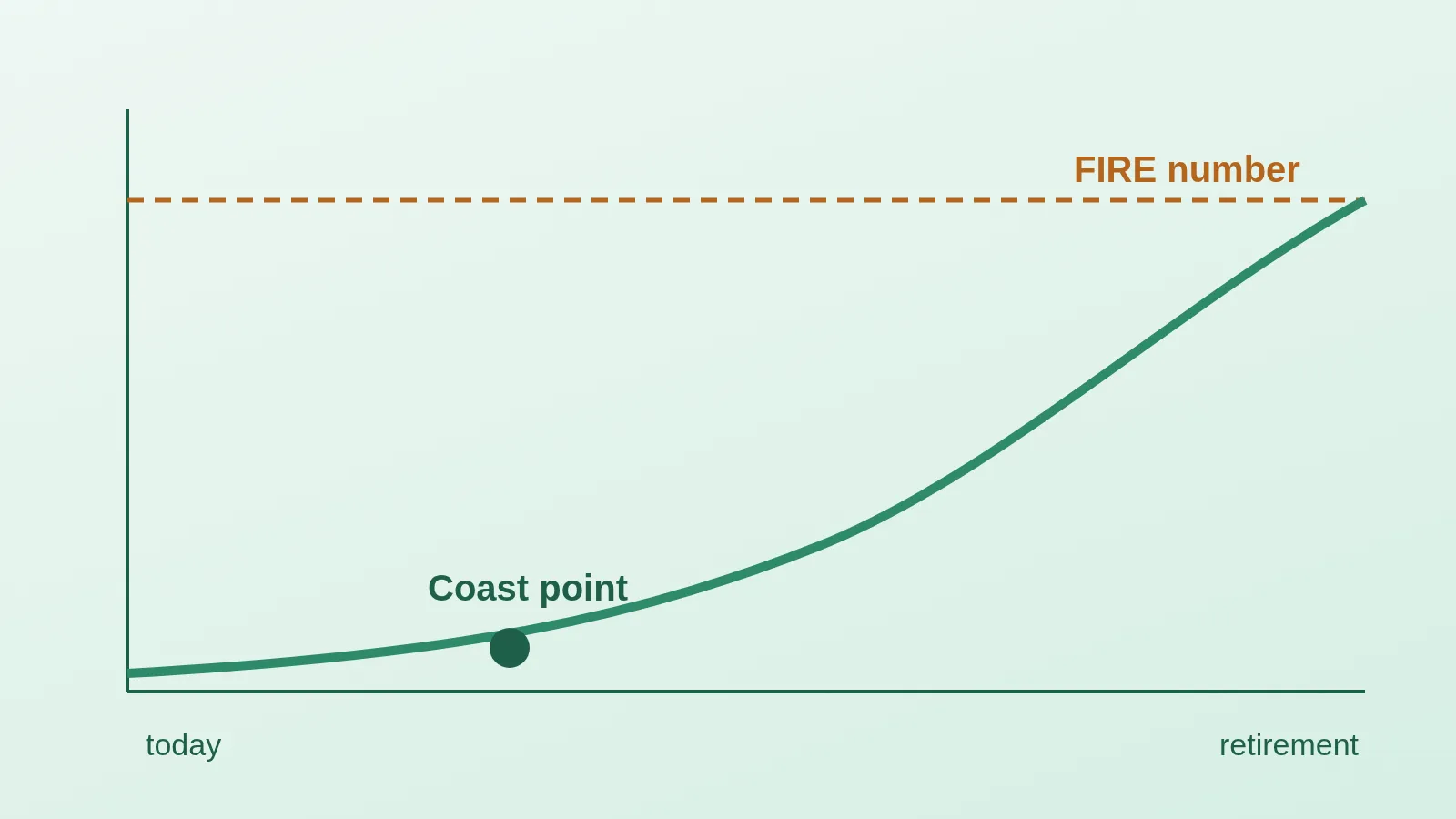
Coast FIRE means you have already invested enough that, with no further contributions, the money could grow to your full FIRE number by your chosen retirement age. You still work to pay current bills, but you no longer need to save for retirement on that assumption.
How is the Coast FIRE number calculated?
Take your FIRE number (annual spending the portfolio must cover divided by your withdrawal rate) and discount it by your expected real return for the years left: FIRE number ÷ (1 + real return)years. For $40,000 of spending at 4%, with 30 years at a 5% real return, that is $1,000,000 ÷ 1.0530 ≈ $231,377.
Is CoastMath financial advice?
No. CoastMath is an independent publisher of calculators and educational guides. Results are arithmetic estimates based on the assumptions you enter, not forecasts or recommendations. Consider a fee-only fiduciary adviser for personal advice.